
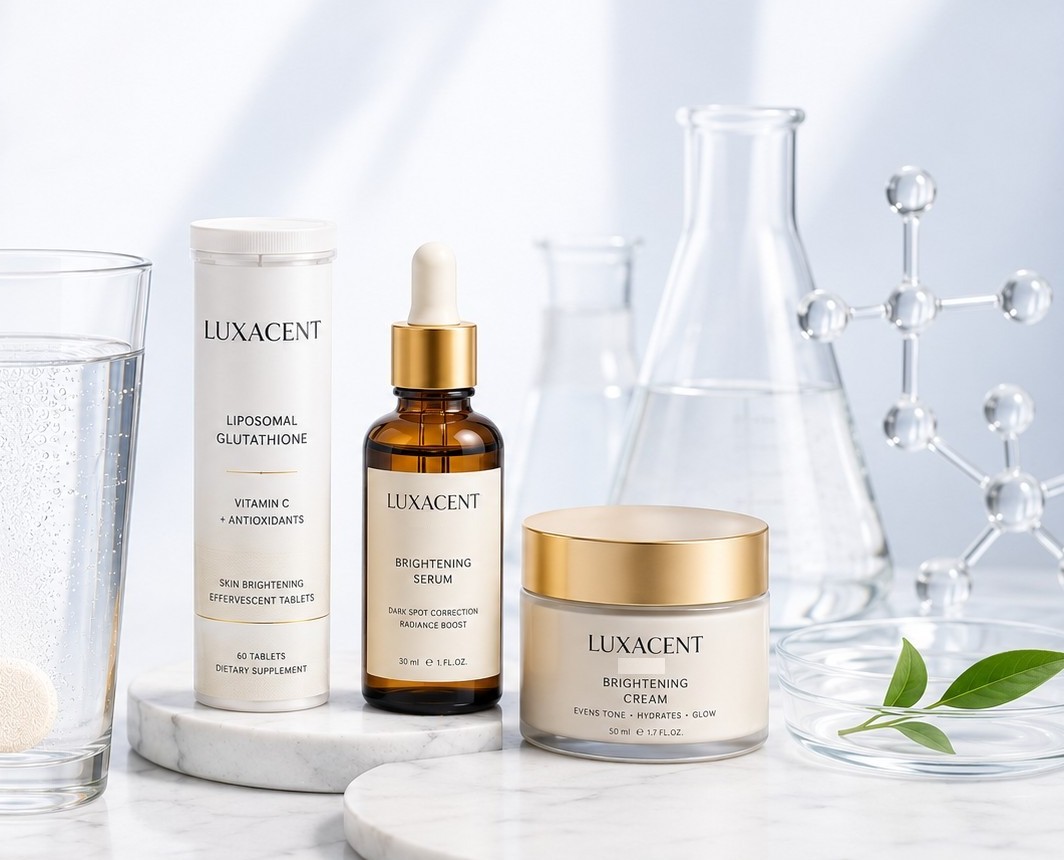
Skin tone is the visible result of a complex biological system. Genetics plays a major role, but pigmentation is also influenced by sun exposure, inflammation, hormones, oxidative stress, age and individual skin characteristics. For that reason, responsible skin-brightening science is not about promising a fixed shade or an identical result for everyone. It is about understanding the pathways involved in pigmentation and selecting ingredients and routines that are relevant to those pathways.
Luxacent takes an evidence-aware approach. Our plans are built around ingredients commonly studied for antioxidant support and skin appearance, while recognizing that the strength of evidence differs by ingredient, formulation and route of use. Scientific research can explain mechanisms and report average outcomes in study groups; it cannot predict the exact response of an individual.
Understanding Melanin and Skin Pigmentation
Melanin is the pigment that contributes to the color of skin, hair and eyes. It is produced by specialized cells called melanocytes and transferred to surrounding skin cells. Two broad forms of melanin are commonly discussed: eumelanin, which is brown to black, and pheomelanin, which is yellow to red. The balance, distribution and production of these pigments contribute to visible skin tone.
A key enzyme in melanin synthesis is tyrosinase. It participates in the biochemical steps that convert the amino acid tyrosine into melanin. This is why many scientific discussions of pigmentation focus on tyrosinase activity, oxidative balance and the signals that regulate melanogenesis — the process by which melanin is produced.
Pigmentation is dynamic. Ultraviolet exposure can stimulate melanin production as part of the skin's protective response. Inflammation can also contribute to uneven pigmentation, including post-inflammatory darkening. Hormonal influences, age, skin phototype and environmental exposure further explain why two people following the same routine may not respond in the same way.
Why Antioxidants Are Relevant
Oxidative stress occurs when reactive molecules and the body's antioxidant defenses are out of balance. Antioxidants help neutralize reactive species and support normal cellular protection. In skin science, oxidative pathways are relevant because they interact with inflammation, environmental exposure and pigmentation biology.
This does not mean that every antioxidant automatically changes skin tone. The effect of a product depends on the specific ingredient, dose, formulation, bioavailability, duration of use and the individual. The useful scientific question is therefore not simply whether an ingredient is an antioxidant, but whether human studies support a meaningful effect for the intended use.
Glutathione: A Central Antioxidant
Glutathione is a naturally occurring tripeptide made from glutamate, cysteine and glycine. It is present throughout the body and participates in antioxidant defense and redox balance. Reduced glutathione, often abbreviated GSH, can donate electrons in antioxidant reactions and is then converted into its oxidized form. Cellular systems can recycle oxidized glutathione back toward its reduced state.
Glutathione has attracted particular interest in pigmentation research because laboratory and clinical literature suggests several possible links with melanogenesis. Proposed mechanisms include interaction with tyrosinase-related pathways, antioxidant effects and a possible shift in melanin synthesis toward lighter pheomelanin rather than darker eumelanin. These mechanisms are biologically plausible, but a mechanism alone is not proof of a predictable cosmetic result.
What Human Research on Oral Glutathione Shows
Human studies of oral glutathione have produced promising but variable findings. A randomized, double-blind, placebo-controlled study published in the Journal of Dermatological Treatment evaluated 500 mg of oral glutathione per day for four weeks in 60 healthy participants. Melanin indices decreased at the measured sites in the glutathione group, but statistically significant differences versus placebo were found at only two of the six sites. The authors therefore described skin lightening in a limited number of participants rather than a universal effect.
Other randomized studies have examined lower daily amounts, longer periods and combinations with other ingredients. Some have reported improvements in melanin index or other skin measurements, while others have found differences that were not statistically significant. A 2025 systematic review identified several randomized trials of oral glutathione and concluded that oral and topical forms can produce moderate skin-lightening effects, while also emphasizing variable study quality, limited durability data and the need for stronger evidence.
The practical conclusion is important: oral glutathione has genuine clinical research behind it, but the evidence does not justify guaranteed outcomes, a guaranteed number of shades, or a universal timeline. Results may differ substantially between individuals.
Liposomal Delivery and Bioavailability
For oral ingredients, formulation matters because an ingredient must survive digestion and become available to the body before it can participate in systemic biological processes. Liposomal formulations encapsulate ingredients within lipid-based structures. They are used in supplements with the objective of improving stability, absorption or delivery compared with conventional formulations.
The term "liposomal" should not be treated as a guarantee of superior clinical results. Bioavailability depends on the actual formulation, manufacturing quality and ingredient characteristics. Luxacent therefore presents liposomal delivery as a formulation approach rather than as proof that every user will experience a stronger or faster visible effect.
Learn more about the formulation components on our Ingredients page.
The Role of Vitamin C and Supporting Nutrients
Vitamin C is a well-established antioxidant nutrient and is also required for normal collagen formation. In skin science it is frequently discussed alongside glutathione because antioxidant systems do not operate in isolation. Vitamin C can participate in redox cycling and may complement broader antioxidant strategies.
Vitamin E is a lipid-soluble antioxidant that helps protect cell membranes from oxidative damage. Zinc contributes to numerous enzymatic processes and normal immune function. Other ingredients used in nutritional formulations may support antioxidant status or general skin condition through different pathways. Their presence should be understood as part of a formulation strategy, not as evidence that each ingredient independently produces skin lightening.
Skin Brightening Is Not a Single Biological Switch
Marketing language can make pigmentation sound as if it were controlled by one switch. In reality, visible tone reflects melanin production, melanin distribution, skin renewal, sun exposure, inflammation and many individual variables. A scientifically responsible approach therefore avoids promising that one ingredient can override genetics or permanently determine skin color.
This is also why changes, when they occur, are generally discussed as progressive rather than instantaneous. The appearance of the skin evolves with biological turnover and ongoing environmental exposure. Sun protection and a consistent skincare routine remain relevant to the appearance of uneven pigmentation regardless of the supplement strategy chosen.
What Science Can — and Cannot — Predict
Clinical trials are designed to determine whether an intervention produces a measurable effect across a study population. They do not establish the exact outcome for a specific person. Differences in baseline skin tone, genetics, sun exposure, nutrition, adherence, metabolism and other factors can all affect observed results.
For Luxacent, this distinction is central. We use scientific literature to inform how we describe ingredients and biological pathways, but we do not convert population-level findings into personal guarantees. Before choosing an option, customers should understand that visible changes may be subtle, variable or absent.
For our consumer-facing explanation of variability, see Results and our FAQ.
A Note on Injections and Medical Administration
The evidence and safety profile of a substance can differ significantly depending on how it is administered. Scientific reviews distinguish oral and topical glutathione from intravenous use. Recent systematic reviews report that evidence supporting intravenous glutathione for skin lightening is limited and raise safety concerns; there is no well-established standardized cosmetic dosing protocol supported by robust long-term evidence.
Injectable products should therefore never be treated as ordinary self-administered supplements. Any injectable or intravenous product requires appropriate professional assessment, lawful supply and administration in accordance with the rules applicable in the user's country. Luxacent's educational content is not a substitute for medical advice, diagnosis or supervision.
Our Evidence-Aware Approach
Luxacent is designed to make complex product choices easier without turning scientific uncertainty into marketing certainty. We focus on transparent ingredients, clear plan structure and realistic information. Where research is encouraging, we say so. Where evidence is limited, mixed or dependent on individual response, we say that too.
This approach matters particularly in skin-brightening products, where exaggerated claims are common. We do not believe that credibility comes from promising a precise result. It comes from explaining what is known, what is still being studied and what factors customers should consider before choosing an option.
How to Use This Information
The Science page is intended as a foundation. If you want to understand what is inside Luxacent formulations, continue to the Ingredients page. If you want help comparing available options, use Find Your Plan. If you want to understand why results vary and how to set realistic expectations, review the Results page and FAQ.