
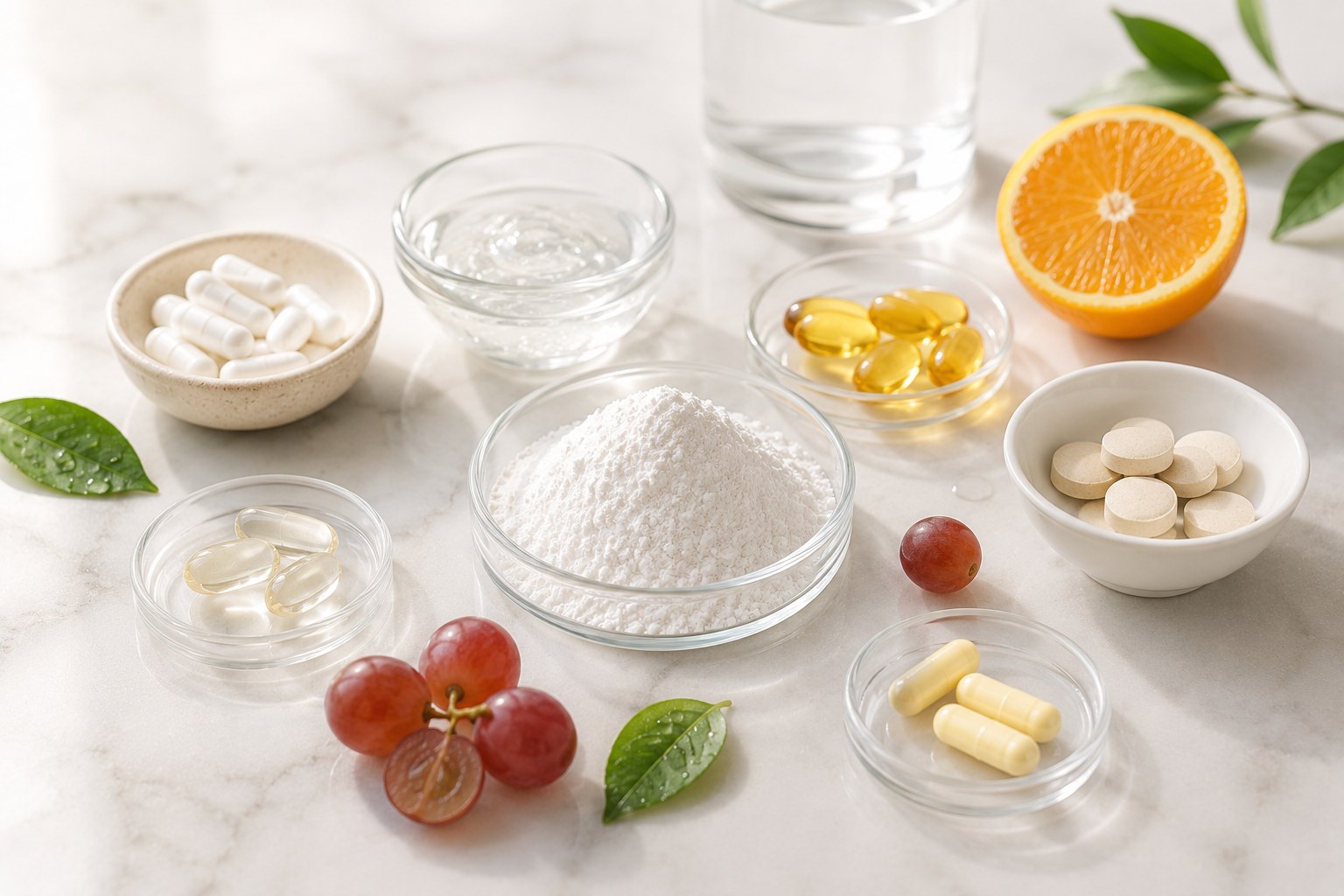
Skin appearance is influenced by more than one biological process. Pigmentation depends on melanin production and distribution, while brightness, elasticity and visible signs of aging are also affected by oxidative stress, collagen integrity, hydration, cellular energy and environmental exposure. This is why a well-designed skin-support strategy should not rely on a single ingredient or a single mechanism. Luxacent focuses on complementary ingredients that can support antioxidant defenses, healthy skin structure and a more even-looking complexion through different biological pathways.
Antioxidants are especially important because reactive oxygen species are continuously generated through normal metabolism and can increase with ultraviolet exposure, pollution and other environmental stressors. The body already has its own antioxidant network, including glutathione and antioxidant enzymes, while nutrients such as vitamins C and E contribute additional support. Some antioxidants work mainly in water-based environments, others protect lipid membranes, and others participate in mitochondrial energy metabolism. Their value therefore lies not only in what each ingredient does individually, but also in how complementary antioxidant systems work together.
For skin brightening, the objective is not to remove melanin or suppress its normal biological purpose. The more responsible approach is to support pathways associated with oxidative balance and pigmentation while maintaining healthy-looking skin. Individual responses vary according to baseline pigmentation, metabolism, sun exposure, consistency and many other factors. For a broader explanation of realistic outcomes, see Results.
Liposomal Glutathione
Glutathione is one of the body's most important endogenous antioxidants. It is a small molecule made from the amino acids glutamate, cysteine and glycine and is present throughout human cells. Its central role is to help maintain redox balance: in practical terms, it participates in systems that neutralize reactive compounds and helps protect cellular components from oxidative stress. Glutathione is also used by enzymes involved in normal cellular defense and the processing of certain compounds.
Its relevance to skin goes beyond general antioxidant protection. Glutathione has been studied for its relationship with melanogenesis, the biological process through which melanin is produced. Published clinical research has reported reductions in measures of pigmentation with some oral and topical glutathione preparations, although results are not uniform and the strength of evidence varies between studies. That makes glutathione an important ingredient to explain carefully: it has a credible antioxidant and pigmentation-related rationale, but it should not be presented as a guaranteed way to achieve a predetermined skin shade.
Liposomal delivery is designed to incorporate an ingredient into lipid-based structures. The formulation concept is intended to protect the ingredient and influence how it is delivered, but the word "liposomal" should not itself be treated as proof of superior clinical results. Within an antioxidant strategy, glutathione is particularly logical alongside vitamin C, which participates in antioxidant recycling and helps reinforce the broader redox network.
Vitamin C
Vitamin C, or ascorbic acid, is an essential water-soluble nutrient and one of the best-known antioxidants relevant to skin biology. Humans cannot synthesize vitamin C and must obtain it from dietary sources. It contributes to normal antioxidant defense and is also an essential cofactor for enzymes involved in collagen formation. Collagen is a major structural protein in skin, so adequate vitamin C status has relevance to the maintenance of normal connective tissue as well as to general health.
In dermatology, vitamin C is particularly interesting because antioxidant activity, collagen biology and pigmentation intersect. Research on topical vitamin C describes antioxidant, anti-aging and antipigmentary mechanisms, including effects related to melanin formation. This does not mean that vitamin C produces the same visible result in every person, but it explains why it is frequently used in routines designed around brightness, uneven-looking tone and photoaging.
Vitamin C also illustrates why antioxidant combinations matter. It can help regenerate oxidized vitamin E, creating a complementary relationship between a water-soluble antioxidant and a lipid-soluble antioxidant. In a broader formulation, vitamin C therefore fits naturally with vitamin E and glutathione rather than functioning as an isolated "whitening ingredient."
Vitamin E
Vitamin E refers to a family of fat-soluble compounds with antioxidant activity. Its biological importance is closely connected to the protection of lipid structures, including cell membranes, from oxidative damage. Because skin is continuously exposed to environmental stress, lipid-phase antioxidant protection complements the water-phase antioxidant activity associated with vitamin C.
For skin appearance, vitamin E is best understood as a supporting antioxidant rather than as a standalone skin-lightening promise. By helping protect lipids from oxidative stress, it contributes to the broader environment in which healthy skin barrier function and cellular integrity are maintained. Its general biological role also extends beyond skin because vitamin E contributes to antioxidant protection throughout the body.
The strongest formulation story is its association with vitamin C. Vitamin C can help restore vitamin E after oxidation, while vitamin E protects lipid environments that vitamin C does not occupy in the same way. This is a good example of complementary antioxidant chemistry: different ingredients can reinforce different parts of the same protective network.
Alpha-Lipoic Acid
Alpha-lipoic acid, often abbreviated ALA, is a naturally occurring sulfur-containing compound involved in mitochondrial metabolism. Mitochondria are the structures that help cells convert nutrients into usable energy. Alpha-lipoic acid also participates in redox chemistry and can exist in oxidized and reduced forms, which helps explain its interest as part of an antioxidant system.
For skin, ALA is more relevant to oxidative stress and skin aging than to a direct whitening mechanism. Oxidative stress contributes to processes associated with visible aging, including changes affecting collagen, elastin and cellular function. Research has therefore explored alpha-lipoic acid in relation to skin senescence and broader age-related oxidative processes. It should be positioned as an antioxidant and metabolic-support ingredient, not as a guaranteed depigmenting agent.
ALA is particularly interesting in a multi-antioxidant concept because antioxidant systems are interconnected. It can sit alongside glutathione, vitamins C and E and CoQ10 as part of a broader strategy addressing different aspects of oxidative balance and cellular metabolism.
Coenzyme Q10
Coenzyme Q10, or CoQ10, is a naturally occurring lipid-soluble molecule with two important biological roles: it participates in mitochondrial energy production and also functions as an antioxidant. This combination makes CoQ10 especially relevant when discussing skin vitality, because healthy skin cells require energy while also being exposed to oxidative stress.
CoQ10 levels in skin can decline with age and environmental stress. Research on skin aging has examined how CoQ10 supplementation, particularly in topical formulations, can support antioxidant levels and cellular energy metabolism. Clinical and experimental literature has also reported improvements in some visible parameters associated with aging skin. These findings support a role in skin vitality and antioxidant defense, but they do not make CoQ10 a direct skin-whitening ingredient.
Within a combined formulation, CoQ10 adds a lipid-soluble, mitochondria-related dimension to the antioxidant network. It complements the roles of glutathione, vitamin C, vitamin E and alpha-lipoic acid rather than duplicating them.
Hyaluronic Acid
Hyaluronic acid is a naturally occurring molecule found in connective tissues and is well known for its ability to bind water. In skin, hydration has a major influence on softness, flexibility and the way light reflects from the surface. Well-hydrated skin can therefore appear smoother and more radiant even though hydration itself does not reduce melanin production.
This distinction matters. Hyaluronic acid should not be described as a whitening active. Its role is complementary: it supports hydration and the extracellular environment while antioxidant ingredients address other aspects of skin biology. More broadly, hyaluronic acid is found throughout the body, including in connective tissue, joints and the eye, where its water-binding and structural properties are biologically important.
Zinc
Zinc is an essential mineral required for the activity of numerous enzymes and proteins throughout the body. It contributes to normal immune function, protein synthesis, DNA synthesis and tissue maintenance. Skin has a continuous need for normal cellular renewal and repair, which makes adequate zinc status relevant to general skin health.
Zinc should not be marketed here as a direct skin-whitening ingredient. Its value is supportive: it participates in normal biological processes that help maintain healthy tissues and complements an ingredient strategy focused on overall skin condition rather than pigmentation alone. It also belongs naturally in a broader nutritional context alongside antioxidant vitamins and other micronutrients.
Grape Seed Extract
Grape seed extract is valued primarily for its polyphenolic compounds, including proanthocyanidins. Polyphenols are plant-derived compounds widely studied for antioxidant properties and their interactions with oxidative pathways. In a skin-focused formulation, grape seed extract adds another category of antioxidant compounds rather than serving as the principal pigmentation-active ingredient.
Its broader interest extends beyond skin because dietary polyphenols are studied in relation to vascular, metabolic and cellular health. For Luxacent, the most coherent role is as part of the antioxidant network: grape seed polyphenols complement endogenous glutathione and antioxidant nutrients such as vitamins C and E. This reinforces the principle that antioxidant support can come from chemically different compounds with different properties.
Biotin
Biotin, also known as vitamin B7, is a water-soluble vitamin that acts as a cofactor for enzymes involved in normal macronutrient metabolism. It is commonly associated with hair, skin and nails, although supplementation should not be presented as producing dramatic cosmetic effects in people who already have adequate biotin status.
Biotin is not a skin-whitening active and should remain a secondary ingredient on this page. Its relevance is nutritional and metabolic: it supports normal enzyme function and belongs to the broader group of nutrients required for normal tissue maintenance. Keeping its role proportionate makes the ingredient story more credible and avoids attributing every benefit of a formulation to every ingredient.
Why Antioxidants Work Better as a System
The central idea behind a multi-ingredient antioxidant approach is complementarity. Antioxidants do not all operate in the same location or through the same chemistry. Vitamin C is water-soluble; vitamin E is lipid-soluble; glutathione is an endogenous cellular antioxidant; CoQ10 participates in mitochondrial energy metabolism and lipid-phase antioxidant defense; alpha-lipoic acid participates in mitochondrial metabolism and redox reactions; and grape seed extract contributes plant polyphenols. Hyaluronic acid, zinc and biotin add different forms of structural, nutritional or metabolic support.
This does not mean that combining more ingredients automatically produces stronger results. Formulation quality, delivery, stability, individual biology, consistency and overall lifestyle all matter. The value of a rational combination is that each ingredient has a defined role rather than being included simply to create a longer label.
To understand how these ingredients fit into the wider evidence base, visit Science. For practical expectations and why visible changes differ between individuals, see Results. If you are comparing tablet and injection plans, explore Skin Whitening Solutions or use Find Your Plan to compare the available formats.
A More Responsible Approach to Skin Brightening
Skin pigmentation is biologically normal and protective, and no ingredient should be presented as a way to erase that function. A responsible skin-brightening approach focuses on supporting a more even-looking complexion, managing oxidative stress, maintaining skin structure and setting realistic expectations. Sun exposure remains particularly important because ultraviolet radiation influences both pigmentation and oxidative stress.
Ingredient information is also not a substitute for medical assessment. Persistent, new, changing or unusual pigmentation can have causes that require professional evaluation. Anyone who is pregnant or breastfeeding, has a medical condition, takes medication, or has questions about supplements or injectable products should seek advice from an appropriately qualified healthcare professional.
Luxacent provides ingredient information so customers can understand why specific components are used and how their roles differ. Continue to the Knowledge Center for deeper educational guidance, or Find Your Plan when you are ready to compare the available options.